Raipur, September 09, 2026: Chhattisgarh has achieved a historic milestone in the fields of water conservation and groundwater management. There is now not a single block in the state that falls under the ‘critical’ category for groundwater extraction. This significant fact has emerged from the Groundwater Resource Assessment-2026.
Officials stated that in 2020, nine blocks in the state were in the critical category, and five blocks remained in this category as recently as 2025. In the 2026 assessment, all five of these blocks have moved out of the critical category.
Moreover, this assessment cycle has recorded an improvement in the groundwater status of 12 blocks across the state, while the situation of not a single block has deteriorated. This marks the most significant single-cycle improvement for Chhattisgarh since the inception of block-wise groundwater assessments. The number of ‘safe’ blocks in the state has now risen to 127.
The Groundwater Resource Assessment-2026, prepared jointly by the Central Ground Water Board and the State Groundwater Survey Board, has been approved by the State-Level Groundwater Assessment and Management Committee.
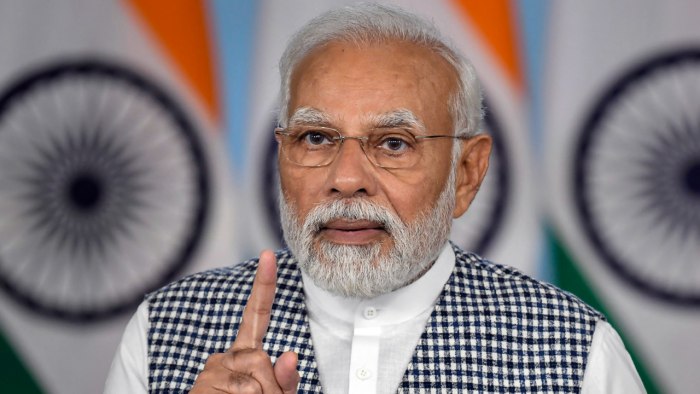
Congratulating the people of the state on this historic achievement, Chief Minister Vishnu Deo Sai expressed his gratitude to Prime Minister Narendra Modi.
He remarked that the Prime Minister’s call to transform ‘Jan Shakti’ (people’s power) into ‘Jal Shakti’ (water power), along with the ‘Jal Sanchay Jan Bhagidari Abhiyan’ (public participation campaign for water conservation) initiated by him, has given a new direction and greater scope to water conservation efforts in the state.
Driven by the participation of various government departments, the district administration, farmers, and ordinary citizens, the initiative for water conservation has now evolved into a widespread mass movement.
Public participation made the seemingly impossible goal possible: Chief Minister Sai
Crediting the state’s farmers, citizens, and field staff for this achievement, Chief Minister Sai stated that this result is not merely due to government policies but is the outcome of public participation and collective resolve.
Sai remarked that this achievement was realized not within the confines of the state secretariat Mahanadi Bhawan, but in the fields and villages. The greatest credit goes to the farmers across the state, including those in Bemetara and Rajnandgaon, who embraced changes in their farming practices to ensure water security for future generations. Our field staff also worked continuously alongside the farmers, season after season.
He noted that, responding to Prime Minister Modi’s call to transform ‘Jan Shakti’ (people’s power) into ‘Jal Shakti’ (water power), Chhattisgarh has demonstrated that public participation can drive significant and lasting change in the realm of groundwater conservation.
The Chief Minister stated that the ‘Jal Sanchay Jan Bhagidari Abhiyan’ (Water Conservation Public Participation Campaign) launched by the Prime Minister provided a robust foundation for the entire administrative machinery to work towards a shared goal. When the participation of farmers and citizens combined with government efforts for water conservation, the result was this historic improvement in groundwater levels.
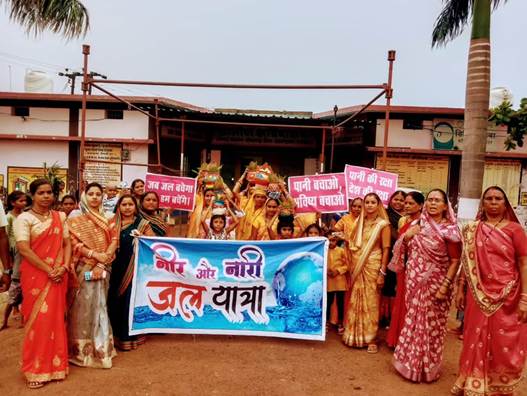
Groundwater recharge reaches a historic high of 14.65 BCM
According to the Groundwater Resource Assessment-2026, the annual groundwater recharge in the state has risen to 14.65 billion cubic meters (BCM), the highest level recorded to date. In 2017, the state’s annual groundwater recharge stood at 11.57 BCM.
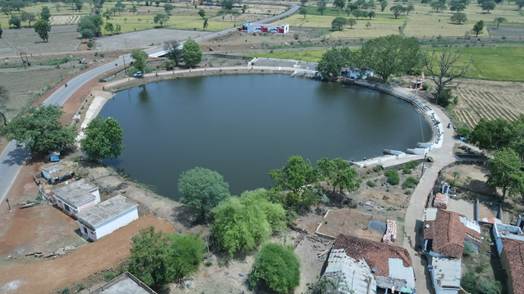
The extensive construction and rejuvenation of water conservation structures have had a direct impact on groundwater recharge. Compared to 2020, a 266.9 per cent increase has been recorded in groundwater recharge from ponds and tanks, and a 202.8 per cent increase from other water conservation structures.
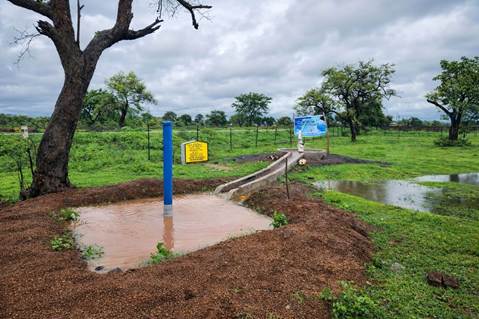
A total of 2,28,736 water structures across the state have been recorded for the 2026 groundwater assessment. Water structures constructed and revived under initiatives such as public participation in water conservation and the ‘Jal Shakti Abhiyan: Catch the Rain’ have played a pivotal role in enhancing groundwater recharge capacity.
First-ever recorded annual decline in groundwater extraction
Another significant aspect of the assessment is the decline in groundwater extraction within the state. Total groundwater extraction was recorded at 6.21 BCM in 2026, compared to 6.30 BCM in the previous assessment cycle. This marks the first such annual decline in available assessment records.
The level of groundwater extraction in the state had peaked at 49.5 per cent in 2022 but has now dropped to 46.37 per cent. This figure remains well below the safe limit of 70 per cent.
This improvement is not merely the result of better rainfall or increased groundwater recharge. The actual reduction in groundwater extraction demonstrates the effectiveness of ground-level efforts regarding better water demand management, crop diversification, water conservation, and farmer participation.
Big change in Bemetara and Rajnandgaon due to crop diversification
In groundwater resource assessment, reduction in paddy area during summer season has been considered as an important reason for reducing groundwater exploitation. Particularly in Bemetara and Rajnandgaon districts, farmers’ participation has yielded remarkable results.
In Bemetara district, the area under summer paddy has reduced from approximately 26 thousand hectares to 5 thousand hectares. Similarly, in Rajnandgaon the area decreased from 9,400 hectares to about 2,800 hectares. The area under summer paddy in both the districts combined has decreased by about 27,600 hectares.
Its impact is clearly visible on the condition of groundwater. Bemetra has come out of the critical category after four consecutive assessment cycles. There has been a decrease of about 20 per cent in the total groundwater exploitation in the district as compared to the year 2023.
There has also been significant improvement in Rajnandgaon. In the year 2022, the level of groundwater exploitation here had reached 70.5 per cent. Now this block has come under completely safe category. Here, a decrease of 16.4 per cent has been recorded in groundwater exploitation for irrigation as compared to the year 2023.
Chief Minister Sai said that this change made in the cropping system by the farmers is an important contribution not only for today but for the water security of the coming generations. By giving priority to long-term interests, farmers have set an exemplary example of water conservation in front of the entire state.
Now special focus on 19 semi-distressed development blocks of 11 districts
Sai said that the achievement of the state is important, but there is still more work to be done in the direction of water security. At present 19 blocks of 11 districts are in semi-critical category. He said that by the year 2030, no block of Chhattisgarh will remain under groundwater stress. Now our special focus will be on semi-distressed development blocks. These will also be brought into safe category through water conservation, groundwater recharging, crop diversification and public participation.
Towards this goal, an aquifer mapping study has been proposed under NAQUIM 2.0 in about 5,442 square kilometer area of Bemetara, Bilaspur and Janjgir-Champa districts during the year 2026-27. This will enable a more scientific assessment of groundwater availability, status of aquifers and area-wise management needs.
It is noteworthy that the improvement in the groundwater situation in the state is not the result of the efforts of any one department. Under Jal Sanchay Jan Bhagidari Abhiyan and Jal Shakti Abhiyan Catch the Rain, various departments including water resources, panchayat and rural development, agriculture, public health engineering and district administration have worked in a coordinated manner.
Efforts like construction and revitalization of water conservation structures in villages, rain water harvesting, groundwater recharging, judicious use of water, crop diversification and motivating farmers for water-less crops were taken forward simultaneously. This holistic approach played an important role in increasing groundwater recharge as well as reducing groundwater exploitation.
Big achievement after the resolution of National Water Summit
This achievement has come to light at a time when Chief Minister Sai had recently presented the work and achievements in the field of water conservation and water security in Chhattisgarh to Prime Minister Narendra Modi in the National Water Summit held on 1 and 2 September 2026.
Under the guidance of Prime Minister Modi, Chhattisgarh has expressed its resolve to move rapidly towards achieving the goals related to water security before the national deadline. The results of Ground Water Resources Assessment-2026 underline the progress of the state in this direction.
The state government is now preparing to take this achievement to the next stage by implementing the annual Catch the Rain Scheme 2026-27 with block level monthly targets. Through this, conservation and recharge works will be made more targeted and result oriented as per the groundwater situation of each area.
The Chief Minister said that water conservation is a pledge for the secure future of the present and future generations. With public participation, Chhattisgarh has brought the number of critical blocks to zero and now with this collective power, we will move towards the goal of making every development block of the state safe from groundwater point of view by the year 2030.