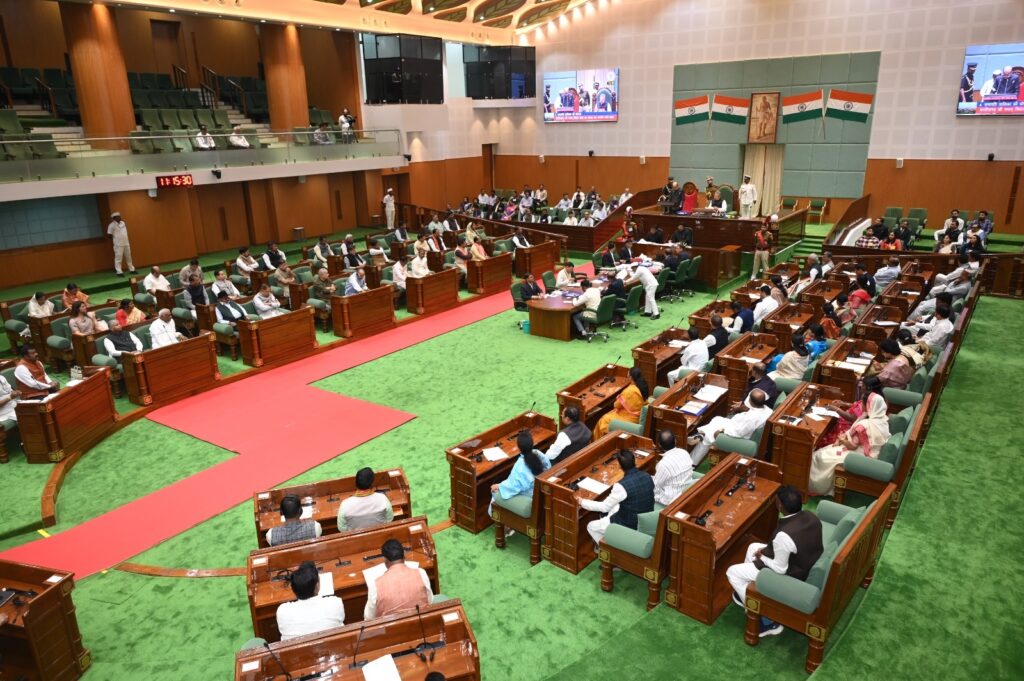
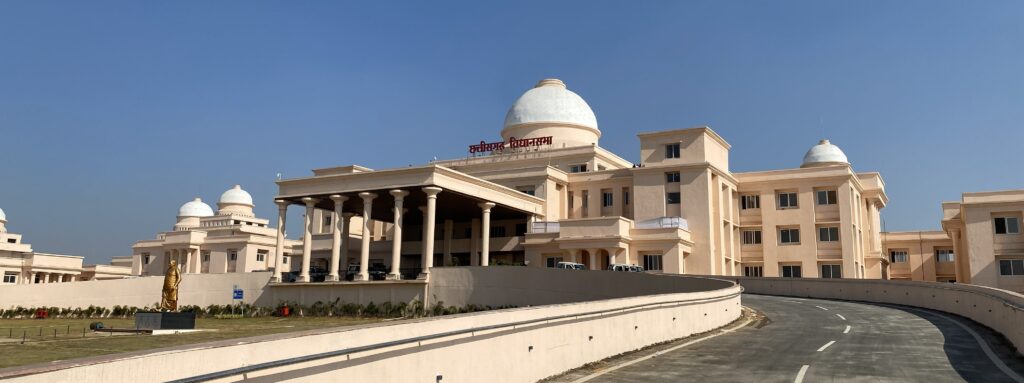
Raipur, March 17, 2026: Demands for grants totaling Rs 10,617 crore, 73 lakh, and 49 thousand—pertaining to the departments under the charge of Chhattisgarh Chief Minister Vishnu Dev Sai—were passed in the State Legislative Assembly today.
These grants include Rs 612 crore, 29 lakh, and 20 thousand for the General Administration Department; Rs 30 crore and 92 lakh for other expenditures related to the General Administration Department; Rs 3,105 crore, 11 lakh, and 80 thousand for the Water Resources Department; Rs 1,145 crore, 89 lakh, and 99 thousand for expenditures related to the Mineral Resources Department; Rs 314 crore, 99 lakh, and 90 thousand for expenditures related to the Aviation Department; Rs 416 crore, 99 lakh, and 99 thousand for the Electronics and Information Technology Department; Rs 77 crore for expenditures related to the Good Governance and Convergence Department; Rs 469 crore and 99 lakh for expenditures related to the Public Relations Department; Rs 4,236 crore, 01 lakh, and 61 thousand for expenditures related to the Energy Department; and Rs 208 crore and 50 lakh for expenditures related to District Projects.
Replying to the discussion on the demands for grants related to his departments in the Legislative Assembly, Chief Minister Sai stated that for the past two years, the state government has been dedicatedly engaged in the service of ‘Chhattisgarh Mahtari’ (Mother Chhattisgarh), and the journey towards a ‘Developed Chhattisgarh’ has already commenced. He emphasized that budget management plays a pivotal role in realising this objective.
The Chief Minister noted that while the themes for the first two budgets were ‘GYAN’ (Knowledge) and ‘GATI’ (Momentum), the theme for the current budget has been designated as ‘SANKALP’ (Resolve).
He further added that by adopting a policy of zero tolerance towards corruption and embracing digital governance, the state government has successfully eliminated systemic leakages; as a result, the hard-earned money of the common people is now being channeled directly into public welfare initiatives.
Citing an example, he stated that under the previous government, the revenue of the Excise Department stood at Rs 5,110 crore, whereas under the current government, it is estimated to have risen to Rs 11,000 crore. This disparity is a result of the crackdown on fraudulent activities.
Describing the ongoing campaign against Naxalism as a major victory for democracy, Sai remarked that the state government has set the elimination of Maoist as its objective and has worked effectively in pursuit of that goal. He noted that a significant number of Naxals have surrendered, thereby reaffirming their faith in democracy and the Constitution.
He characterised this as a celebratory moment for democracy, stating that—guided by Prime Minister Narendra Modi and Union Home Minister Amit Shah, bolstered by the valour of the security forces, and supported by the trust of the state’s citizens—the state is emerging from the darkness of Maoist violence. The focus now lies on strengthening the administrative machinery in Naxal-affected regions to realise the objectives of peace, reconstruction, and holistic development.
The Chief Minister emphasised the pivotal role that mineral revenue plays in the state’s economic growth and job creation.
He highlighted that while mineral revenue stood at Rs 12,305 crore in the year 2021–22, it has surged to Rs 14,592 crore in 2024–25—accounting for 11 per cent of the State Gross Domestic Product (SGDP). Revenue receipts are projected to reach Rs 17,000 crore by the end of the 2025–26 fiscal year. He added that this additional revenue is being channeled into public welfare schemes designed to benefit farmers, women, and the general citizenry.
Sai further stated that, over the past two years, the government has sanctioned irrigation projects worth Rs 11,107 crore, resulting in the creation of an additional irrigation capacity of 25,000 hectares. Stalled irrigation schemes have been revived through the ‘Atal Irrigation Scheme.’ The completion of 115 such projects is expected to extend irrigation facilities to an additional 76,000 hectares of land. Furthermore, this year’s budget has allocated over Rs 4,400 crore specifically for new irrigation projects and their maintenance. He stated that the schemes included in this year’s budget propose irrigation coverage for an area of 160,000 hectares.
Highlighting the potential of the Indravati River—the lifeline of the Bastar region—he outlined provisions for the construction of barrages at Matnar and Deurgaon, along with a 68-kilometer canal, which will facilitate the development of irrigation facilities across 32,000 hectares.
The Chief Minister remarked that, in alignment with the mantra of “Per Drop, More Crop,” pressurised irrigation systems are being adopted, and water management is being placed on a scientific footing through the establishment of a Water Informatics Centre.
The Chief Minister noted that a distinct shift in work culture is evident across the entire administrative machinery—from the Ministry headquarters down to the field-level staff. Systems such as biometric attendance, e-Office, e-HRMS, and SPAROW have rendered governance more accountable, prompt, and transparent.
He informed that over 50,000 officers and employees have already been onboarded onto the e-Office platform, while more than 65,000 employees have joined the e-HRMS system. Furthermore, a comprehensive action plan is currently underway to provide training to 600,000 employees through the iGOT-Karmayogi platform. The Chief Minister asserted that the administrative apparatus is being transformed through the strategic integration of training and technology.
Sai stated that, in its pursuit of good governance, the State Government has established a dedicated Department of Good Governance and Convergence. Initiatives such as the Chief Minister’s Helpline (aimed at enhancing its effectiveness), the Atal Monitoring Portal (designed for the precise oversight of various schemes), the e-District Portal (facilitating the delivery of citizen services), and the Chief Minister’s Good Governance Fellowship (aimed at nurturing a new generation of exemplary public administrators) are currently being implemented.
He further disclosed that budgetary provisions have been allocated as Rs 22 crore for the Chief Minister’s Helpline, Rs 5 crore for the Atal Monitoring Portal, and Rs 8 crore for the Chief Minister’s Good Governance Fellowship.
Chief Minister Sai remarked that the present era is defined by Information Technology (IT) and Artificial Intelligence (AI).
To ensure that Chhattisgarh emerges as a frontrunner in this digital revolution, a budgetary allocation of Rs 417 crore has been made. A sum of Rs 100 crore has been earmarked for the Chief Minister’s AI Mission, through which AI Data Labs and AI Centers of Excellence will be established in higher education institutions, ITIs, and polytechnics.
He stated that this initiative will provide the younger generation with the opportunity to engage with new technologies, while simultaneously making government services more streamlined and effective.
Referring to digital connectivity, he noted that 936 mobile towers have been sanctioned over the past two years, with 751 towers already operational. Under the BharatNet project, approval has been granted for an expenditure of Rs 3,900 crore to provide high-speed internet connectivity to Gram Panchayats. Furthermore, a decision has been taken to establish 36 INC-CG Incubation Centers to foster and encourage startups.
The Chief Minister stated that, in order to propel Chhattisgarh’s development trajectory to new heights, the state government is actively expanding its aviation infrastructure. With the 3C-IFR upgradation of Bilaspur Airport, it will now be possible to facilitate night landings and operate round-the-clock flight services.
An MoU has been signed for the establishment of an International Cargo Terminal, which will provide significant convenience to the business community. Facilities are currently being expanded at the airports in Raipur, Bilaspur, Ambikapur, and Jagdalpur.
Through the ‘CG Vayu’ scheme, air connectivity will be expanded from Bilaspur, Jagdalpur, and Ambikapur—an initiative for which a budgetary provision of Rs 30 crore has been made. The government is also placing special emphasis on the upgradation of airstrips in Raigarh and Korba, he said.
The Chief Minister affirmed that the state government is committed to fostering cultural progress alongside economic development. Through ‘exposure visits,’ journalists were provided with opportunities to undertake study tours across various states of the country; this initiative specifically included journalists from remote regions as well as women journalists.
He added that the organization of the Raipur Literary Festival infuses new energy into the state’s cultural consciousness, and a budgetary allocation has once again been made for this event this year. Additionally, a decision has been taken to organize Pravasi Chhattisgarhiya Sammelan, a conference for expatriate Chhattisgarhi people, through which the new generation will draw inspiration from the experiences of those who have established their identity outside the state.