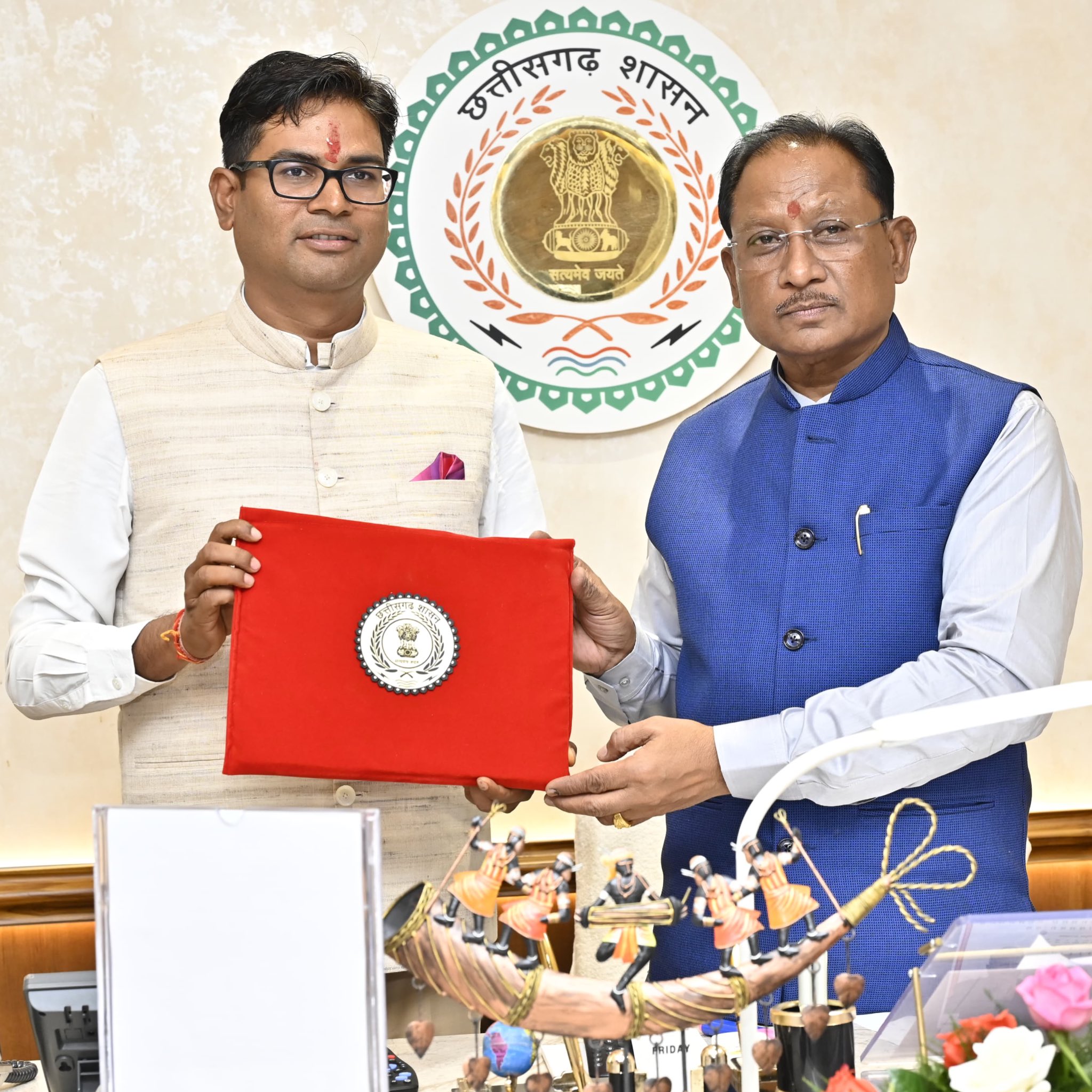
Raipur, February 24, 2026: Presenting his third budget in the Chhattisgarh Assembly, Finance Minister O P Choudhary stated that the appropriation for 2026-27 is ₹1,87,500 crore. Net expenditure, after deducting loan repayments and recoveries from gross expenditure, is estimated at ₹1,72,000 crore. Revenue expenditure is ₹1,45,000 crore, and capital expenditure is ₹27,000 crore.
Chhadri informed the Assembly that for the development of Scheduled Tribes and Scheduled Castes in the state, 34 percent has been allocated under the Tribal Sub-Plan and 12 percent under the Scheduled Caste Special Component Plan.
The 2026-27 budget includes 40 percent allocation for the social sector, 36 percent for the economic sector, and 24 percent for the general services sector.
Discussing the fiscal situation, he said that the state’s gross fiscal deficit for the year 2026-27 is estimated at ₹28,900 crore, which includes a special assistance loan of ₹8,500 crore from the Centre for capital expenditure. The state’s net fiscal deficit will be ₹20,400 crore, which is 2.87 percent of the state’s gross domestic product.
He said that the state’s total revenue receipts are estimated at ₹1,43,000 crore and total revenue expenditure at ₹1,45,000 crore. Therefore, a total revenue deficit of ₹2,000 crore is estimated for the year 2026-27.
The Finance Minister also announced that, in accordance with the BJP’s manifesto, a 50 percent discount on registration fees charged for the purchase of immovable property in the name of women is proposed from next year. Speaking on his budget, the Finance Minister stated that a developed Chhattisgarh by 2047 is our long-term goal, and to achieve this, we have also set a medium-term target of 2030. We are moving forward with a clear roadmap. Each of our budgets represents a step forward on this path.
He stated that the focal point of our development journey has been GYAN, for whose upliftment the GATI strategy was adopted in the previous budget. This year, the theme of our budget for the welfare of GYAN is SANKALP, which underscores our commitment, loyalty, dedication, and determination to the people.
Choudhary explained that any goal is achieved through determination; whether one’s capacity is greater or less, but if one has a strong will and a strong resolve, any goal bows before the determined. SANKALP stands for:
S: Inclusive Development
A: Infrastructure
N: Investment
K: Skilled Human Resources
A: Antyodaya
L: Livelihood
P: From Policy to Results
The Finance Minister said that liberation from Naxalism in Bastar was beyond anyone’s imagination, but the “Iron Man of New India,” Home Minister Amit Shah, pledged to eliminate Naxalism by March 2026 and is making it happen. Now that Naxalism is setting in its waning days, it is the government’s duty to focus its efforts on Bastar’s development while eliminating regional disparities.
Inspired by the experience of the Education City in Dantewada, the government is establishing Education Cities in Abujhmad and Jagargunda, known as Naxalite strongholds. Places that used to be Naxalite strongholds will now become synonymous with centers of education; the youth of Bastar will be seen with gaur horns on their heads and stethoscopes around their necks. We have allocated 100 crore rupees for both Education Cities.
In the last budget speech, a promise was made to introduce the Chhattisgarh Home Stay Policy, which has been implemented. Bastar and Surguja will benefit the most. A provision of 10 crore rupees has been made in the budget for this.
To upgrade healthcare facilities, the government has opened a super-specialty hospital in Jagdalpur. To further expand healthcare facilities in Bastar and Surguja, it has decided to establish medical colleges in Kunkuri, Manendragarh, and Dantewada, with a provision of ₹50 crore for their operation.
He said that, in accordance with the Chief Minister’s announcement, the funding for the Surguja-Jashpur Development Authority has been increased from ₹50 crore to ₹75 crore, and a budget provision of ₹75 crore has been made for the Bastar Development Authority. Under the leadership of Prime Minister Narendra Modi and Chief Minister Vishnu Dev Sai, Bastar and Surguja are experiencing a rise in prosperity. The development of all types of networks, sports, health, and education in these areas reflects our commitment to inclusive development.
A provision of ₹8,200 crore has been made in the budget for the Mahatari Vandan Yojana. Additionally, a provision of ₹120 crore has been made under the Pradhan Mantri Matru Vandana Yojana and ₹80 crore for the Mission Vatsalya Yojana.
Choudhary stated that the Rani Durgavati Yojana will be launched in this budget, through which Noni will receive ₹1.5 lakh upon turning 18. A provision of ₹15 crore has been made for this.
Through the Shaheed Veer Narayan Singh Ayushman Swasthya Yojana, free medical care up to ₹5 lakh has been provided not only in government hospitals but also in non-government hospitals. ₹1,500 crore has been allocated for this scheme.
In addition, ₹350 crore has been allocated for the Mitanin Welfare Fund under the Health Department.
₹190 crore has been allocated for PM ABHIM, ₹183 crore for the Pradhan Mantri Jan Arogya Yojana, and ₹120 crore for the National AYUSH Mission.
This year, a budget provision of approximately ₹9,450 crore has been made under the Public Works Department.
Additionally, a provision of ₹100 crore has been made for undergrounding power lines in Raipur city. The district administration, police administration, and municipal corporation will work together to improve the traffic system in Raipur, and additional funds will be provided for this purpose.
A historic increase in the capital provision for the Water Resources Department has been made, with a provision of ₹3,500 crore.
This budget includes a provision of ₹800 crore for providing relief in electricity bills to domestic consumers. Additionally, ₹354 crore is allocated for providing free electricity to BPL consumers. Under the Pradhan Mantri Suryaghar Free Electricity Scheme, a provision of ₹400 crore has been made for additional state government grants, in addition to the central grant.
In the previous budget, the Chief Minister’s Nagarotthan Yojana was launched for development in municipal corporations. In this budget, a new scheme, the Chief Minister’s Adarsh Shahar Samriddhi Yojana, has been proposed for the overall development of municipalities and town councils, along with the Nagarotthan Yojana, for which a provision of ₹200 crore has been made.
In addition, ₹750 crore has been allocated for infrastructure development in all urban bodies, ₹450 crore for the Nagarotthan Yojana, ₹800 crore for the Pradhan Mantri Awas Yojana 2.0, and ₹512 crore under the Mission Amrit Yojana.
The budget for the Industry Department was ₹648 crore in 2024-25, which is increasing to ₹1,750 crore this year. To promote entrepreneurship in the state, the budget for industrial subsidies has been increased threefold, and this time, a provision of ₹750 crore has been made for grants and reimbursements. A provision of ₹200 crore has been made for creating a land bank for the establishment of new industrial areas.
The government has allocated ₹5,000 crore in the budget under the Chief Minister’s Food Assistance Scheme and ₹1,000 crore for gram, sugar, fortified rice, jaggery, and iodized salt to provide complete nutrition security.
A total provision of ₹1,422 crore has been made for various pension schemes under Social Security Assistance.
₹20 crore has been provided for the operation of de-addiction centers in all 33 districts of the state.
Budgetary provision has also been made for the Transgender Welfare Board.
₹128 crore has been provided for the safety and welfare of unorganized workers. A provision of ₹600 crore has been made for landless agricultural labourer families under the Deendayal Upadhyaya Landless Agricultural Labourer Scheme.
The state government has achieved a historic procurement of 437 lakh metric tonnes of paddy in the last three Kharif seasons, including the purchase of 142 lakh metric tonnes of paddy in the 2025-26 Kharif season. This has enabled payments of over ₹1.40 lakh crore to farmers. To encourage crop diversification, crops such as pulses, oilseeds, maize, kodo-kutki, ragi, and cotton have also been included in the Krishak Unnati Yojana. A provision of ₹10,000 crore has been made in this budget for the Krishak Unnati Yojana.
Markfed plays a vital role in paddy procurement, hence a provision of ₹6,000 crore has been made for Markfed to procure paddy.
A provision of ₹5,500 crore has been made to provide free electricity to farmers for agricultural pumps. Additionally, ₹820 crore has been allocated for the Prime Minister’s Crop Insurance Scheme, ₹170 crore for the Integrated Watershed Management Program, ₹150 crore for the Farmer’s Comprehensive Development Scheme, ₹130 crore for the Prime Minister’s Agricultural Irrigation Scheme, and ₹130 crore for the National Agricultural Development Scheme.
Over ₹1,700 crore has been allocated this year under the Pradhan Mantri Gram Sadak Yojana (PMGSY). This includes projects such as 70 new roads and 21 bridges.
The Finance Minister stated that he had fought for people’s right to housing, launched the “More Housing, More Rights” campaign, and since his government came to power, he has approved 2.6 million houses. This budget also includes a provision of ₹4,000 crore for the Pradhan Mantri Awas Yojana (Rural).
This year, permission was granted for recruitment to 1,587 posts for the Bastar Fighter Force in Bastar, and 1,500 new posts have been created for the Bastar Fighter Force in the coming year. Over the past two years, the state government has created approximately 6,000 posts for the Home Department and initiated recruitment for over 4,000 more.
To ensure sustained income for forest produce collectors and forest management committees, a provision of ₹930 crore has been made for forest conservation. Additionally, provisions have been made for the creation of over 1,000 posts in the Forest Department.
This year, the Public Relations Department has a total budget of ₹475 crore for publicity of schemes.
A new cashless medical facility scheme is being launched for state government employees. Under this scheme, employees will be able to receive cashless treatment through e-health cards. A budgetary provision of ₹100 crore has been made for this.
Choudhary stated that the pace of development he envisions cannot be achieved with a simple growth rate; it requires mission-based work in identified areas. To this end, we are launching five missions through this budget. Each mission will receive a minimum of ₹100 crore annually for the next five years.
They are the Chief Minister’s AI Mission, the Chief Minister’s Tourism Development Mission, the Chief Minister’s Sports Excellence Mission, the Chief Minister’s Infrastructure Mission, and the Chief Minister’s Start-up and NIPUN Mission.