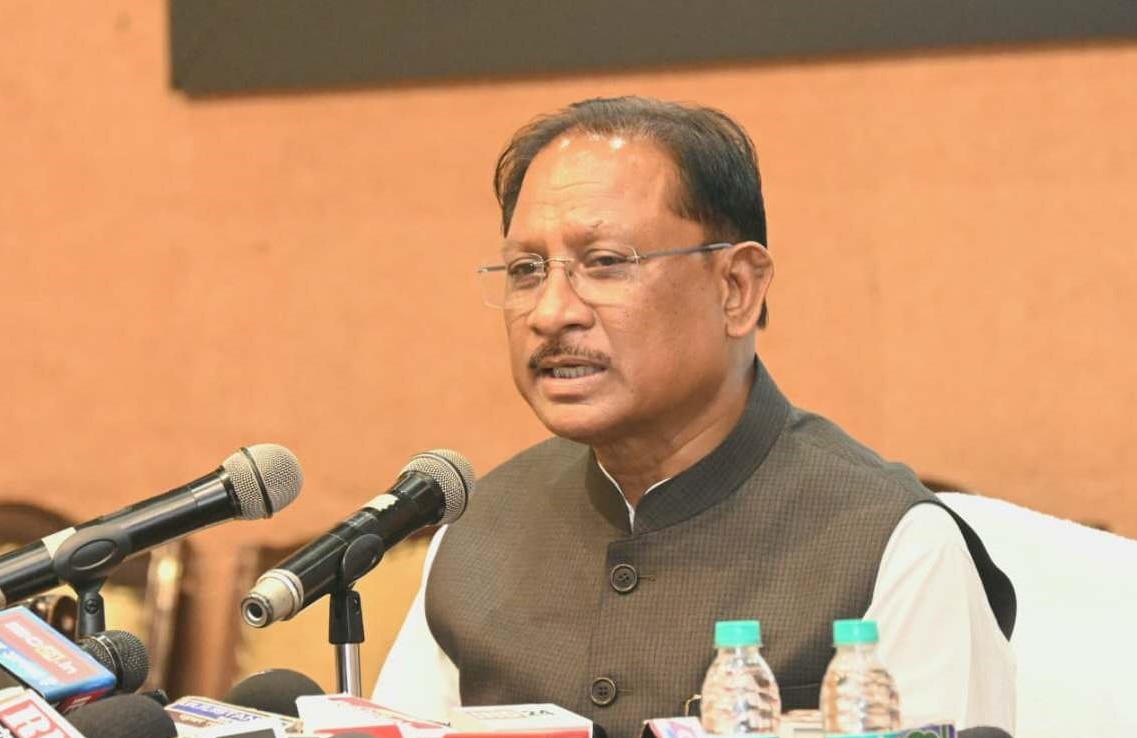
Raipur, July 3, 2026: Chhattisgarh Chief Minister Vishnu Dev Sai today conducted a high-level review meeting regarding issues such as the potential for scanty rainfall during the Kharif 2026 season, the availability of fertilizers and seeds, water conservation, irrigation management, scientific farming, and rural employment.
At his official residence, he reviewed the preparations made by the Agriculture Department and the Viksit Bharat-VB-G RAM G Scheme in light of the anticipated low rainfall conditions for the Kharif 2026 season.
The Chief Minister stated that the interests of farmers are paramount and that, under no circumstances, would they face a shortage of fertilizers, seeds, technical guidance, or essential resources.

He instructed officials to ensure that all departments work in coordination to prepare action plans tailored to the local conditions of each district.
Sai mentioned that he had recently requested Union Minister for Health & Family Welfare and Chemicals & Fertilizers, Jagat Prakash Nadda, to provide additional DAP fertilizer to meet the needs of Chhattisgarh’s farmers.
As a positive outcome of this request, Chhattisgarh has received a supply of over 46,000 tonnes of DAP, an amount exceeding the usual allocation, he said adding this would ensure the timely availability of fertilizer to farmers and prevent any hindrance to Kharif season preparations.

The Chief Minister directed officials to ensure adequate arrangements for irrigation water required for the paddy crop. He emphasized the need for scientific management of water sources, particularly in rain-fed areas, so that irrigation facilities could be provided to farmers when needed.
He instructed the Agriculture Department to raise widespread awareness among farmers regarding short- and medium-duration paddy varieties, Direct Seeded Rice (DSR), line sowing methods, seed treatment, moisture conservation, and modern scientific farming techniques.
Additionally, he called for a special campaign to increase the acreage of pulse and oilseed crops in upland areas, thereby providing farmers with better income opportunities and reducing agricultural risk.
Sai appealed to farmers to contact experts from agricultural colleges, Krishi Vigyan Kendras (KVKs), research institutes, and the Agriculture Department for any agriculture-related issues or technical advice, and to adopt scientific farming practices.
Issuing instructions for strict action against the sale and black marketing of substandard seeds and fertilizers, he stated that any irregularities affecting farmers would not be tolerated.
It was reported during the meeting that adequate stocks of fertilizers and seeds are available in the state, and necessary arrangements have been made to ensure timely supply across all districts.
The meeting also noted that all preparations have been completed to provide early-variety paddy seeds to farmers through the Seed Corporation.
Sai stated that water conservation would be turned into a public participation campaign to effectively tackle potential situations like scanty rainfall. While directing that the ‘Mor Gaon Mor Pani’ (My Village, My Water) campaign be made more effective, he emphasized prioritizing activities related to rainwater harvesting, farm ponds, the construction of water structures, and groundwater recharge.
He instructed officials to widely publicize the ‘Sachet’, ‘Damini’, and ‘Meghdoot’ mobile apps, developed by the India Meteorological Department, to ensure farmers’ safety against natural disasters like lightning strikes and to facilitate the timely delivery of weather-related information to them.
Additionally, he directed that herbicides be made available to farmers at reasonable rates through cooperative societies to reduce production costs and protect crops.
The Chief Minister instructed that the bulletins regularly issued by the Agricultural University be widely publicized. He called for an effective public awareness campaign to ensure this information reaches farmers at the grassroots level, while also ensuring extensive dissemination through both social media and traditional media channels.
Senior officials from agriculture, meteorology, and related departments attended the meeting, including the Chief Minister’s Principal Secretary Subodh Kumar Singh, Agriculture Production Commissioner (APC) Siddharth Komal Pardeshi, Secretary of the Revenue and Disaster Management Department Shammi Abidi, Director of Agriculture Rahul Dev, Commissioner of the Viksit Bharat-VB-G RAM G Scheme Taran Prakash Sinha, India Meteorological Department expert Gayatri Vani, and Director of Research Services at Indira Gandhi Agricultural University Vivek Kumar Tripathi.