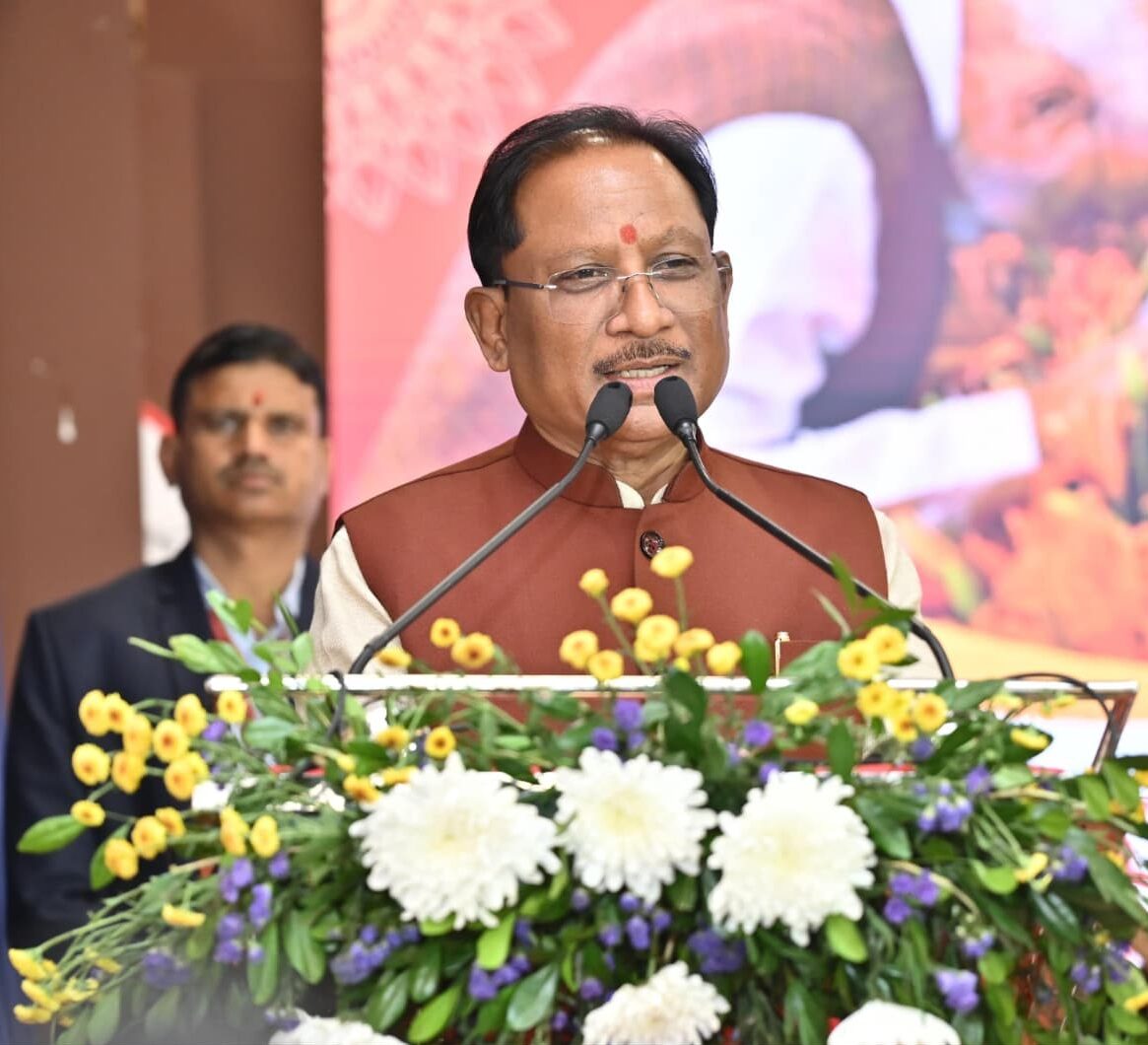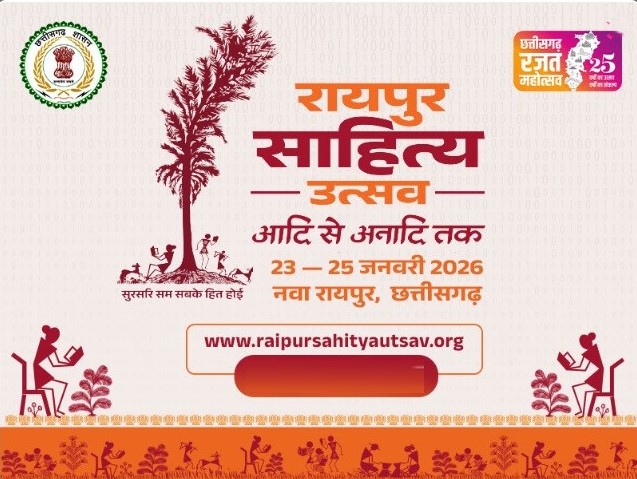
Raipur, January 23, 2026: The Raipur Sahitya Utsav 2026 was grandly inaugurated today in Nava Raipur, Chhattisgarh.
Rajya Sabha Deputy Chairman Harivansh inaugurated the the ceremony and under the Chairmanship of Chief Minister Vishnu Dev Sai.
Deputy Chairman Harivansh began his address by paying tribute to the great litterateur of Chhattisgarh, late Vinod Kumar Shukla, and said that Chhattisgarhi literature has a rich and ancient tradition, and this state has always strongly preserved its local culture.

Harivansh said that a very creative approach is clearly visible in the organisation of the Raipur Literature Festival. Referring to Kabir’s deep connection with Kashi, he mentioned that Kabir also had a special connection with Kawardha in Chhattisgarh.
The Rajya Sabha Deputy Chairman said that even a single book and a single author have the power to change the world. Referring to the lines of National Poet Maithilisharan Gupt, he said that literature guides society, instills hope, rescues from despair, and provides the courage to live life.
The ceremony was held at the Vinod Kumar Shukla Pavilion, with Deputy Chief Minister Arun Sao, Vice-Chancellor of Mahatma Gandhi International Hindi University Wardha Dr. Kumud Sharma, and renowned theater artist and actor Manoj Joshi present as special guests.

On this occasion, Chief Minister’s Media Advisor Pankaj Jha, senior journalist Anant Vijay, and President of Chhattisgarh Sahitya Akademi Shashank Sharma, along with many other dignitaries, were present.
On the occasion of the inauguration, a booklet based on the completion of 25 years of Chhattisgarh state, a coffee table book on the litterateurs of Chhattisgarh state, a book titled “National Selfhood in Science” written by J. Nandkumar, Professor Anshu Joshi’s book “Lal Deewarein, Safed Jhooth,” and Rajiv Ranjan Prasad’s book “Tera Raj Nahin Aayega Re” were released by the guests.
Deputy Chairman Harivansh said that today India is the world’s fastest-growing economy and the resolution of a developed India by 2047 is our national goal. He said that India is playing a leading role in the fields of steel, rice production, and startups. The country’s self-reliance has given a new direction to the world, and literature has played a powerful role behind this national strength.
Chief Minister Vishnu Dev Sai, in his address, stated that Chhattisgarh is the maternal home of Lord Rama, and the inauguration of the three-day Raipur Literature Festival on this sacred land is a matter of pride for all of us.

Welcoming the writers and literature enthusiasts from across the country, he said that the Raipur Literature Festival 2026 is a grand confluence of literature, in which more than 120 renowned writers from the state and various states of the country are participating. During the event, in a total of 42 sessions, there will be in-depth discussions on contemporary social, cultural, and political issues. This is the time of the Amrit Kaal of the Republic and the Silver Jubilee year of Chhattisgarh state, and this festival has been organized in accordance with this spirit, he said.
Comparing the freedom struggle to the churning of the ocean, the Chief Minister said that just as both poison and nectar emerged from the churning of the ocean, similarly, in the freedom movement, our freedom fighters endured the poison-like hardships themselves and provided the nectar of freedom to the coming generations.

He said that many of our freedom fighters were also writers, journalists, and lawyers. Works like “Pushp Ki Abhilasha” (The Desire of a Flower), composed by Makhanlal Chaturvedi in Bilaspur jail, inspired the countrymen. Madhavrao Sapre’s story “Ek Tokri Bhar Mitti” (A Basketful of Earth) is considered the first Hindi story.
Sai mentioned writers like Pandit Lochan Prasad Pandey, Padumlal Punnalal Bakshi, and Gajanan Madhav Muktibodh, saying that preserving their memories is our cultural responsibility. The construction of the Triveni Museum in Rajnandgaon is a symbol of this sentiment.
The Chief Minister said that the pavilions of the Raipur Literature Festival have been dedicated to great writers like Vinod Kumar Shukla, Shyam Lal Chaturvedi, Lala Jagdalpuri, and Anirudh Nirav, who have given a new identity to the culture and literature of Chhattisgarh. He said that poetry teaches resistance against injustice, and this is the real power of literature.
Referring to the poetry recitation programme organised in memory of former Prime Minister Atal Behari Vajpayee, the Chief Minister said that Atal Ji was a poet at heart, and his poems inspired millions of people. Lines like “Haar Nahin Manunga (I will not give up…)” still inspire and empower people today.
The Chief Minister, while highlighting the role of writers during the Emergency period, quoted Dushyant Kumar’s famous lines and said that the large number of young literature enthusiasts participating in this festival today clearly shows that the literary environment in the state is vibrant and strong. He expressed confidence that this three-day event would prove to be a milestone.
On this occasion, he also paid tribute to the late Surendra Dubey.
Deputy Chief Minister Arun Sao, describing the festival organized on the auspicious occasion of Basant Panchami as a grand confluence of literature, said that the land of Chhattisgarh has given many great pioneers to Hindi literature.
Dr. Kumud Sharma said that in this Amrit Kaal, the resolve for a self-reliant India and Swadeshi (indigenous) products is the foundation of our bright future. Sharma described literature as a powerful medium for self-awareness and cultural consciousness and called India the mint of human culture.
After the inaugural ceremony, the guests and literary figures participated in various sessions, sharing their views on contemporary literature, culture, democracy, and society. A large number of literature enthusiasts were present during the programme, and the active participation of the youth was particularly noteworthy.
This inauguration of the Raipur Literature Festival 2026 is proving to be a significant step towards literary dialogue, exchange of ideas, and the expansion of cultural consciousness.