Raipur, February 08, 2026: Union Home and Cooperation Minister Amit Shah today said that the previous Congress government in Chhattisgarh had provided shelter to the Naxal movement.
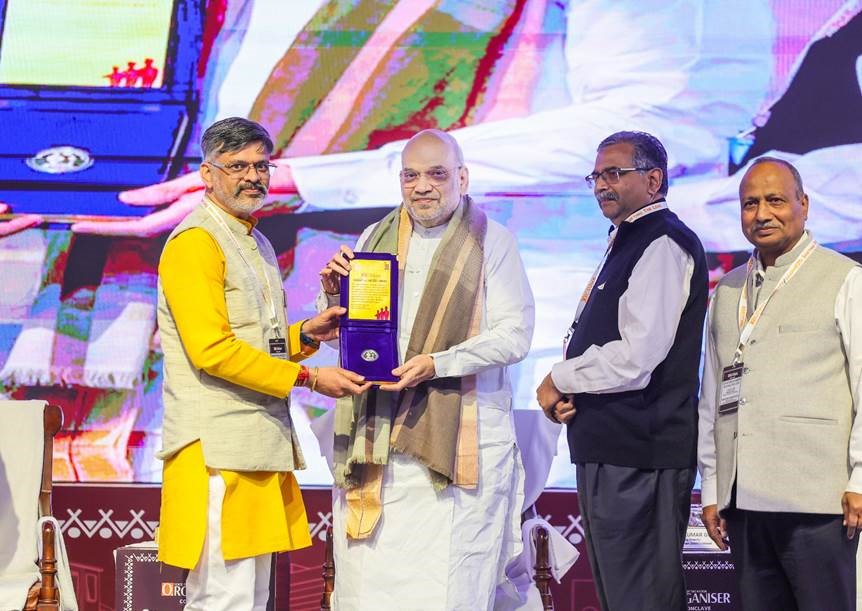
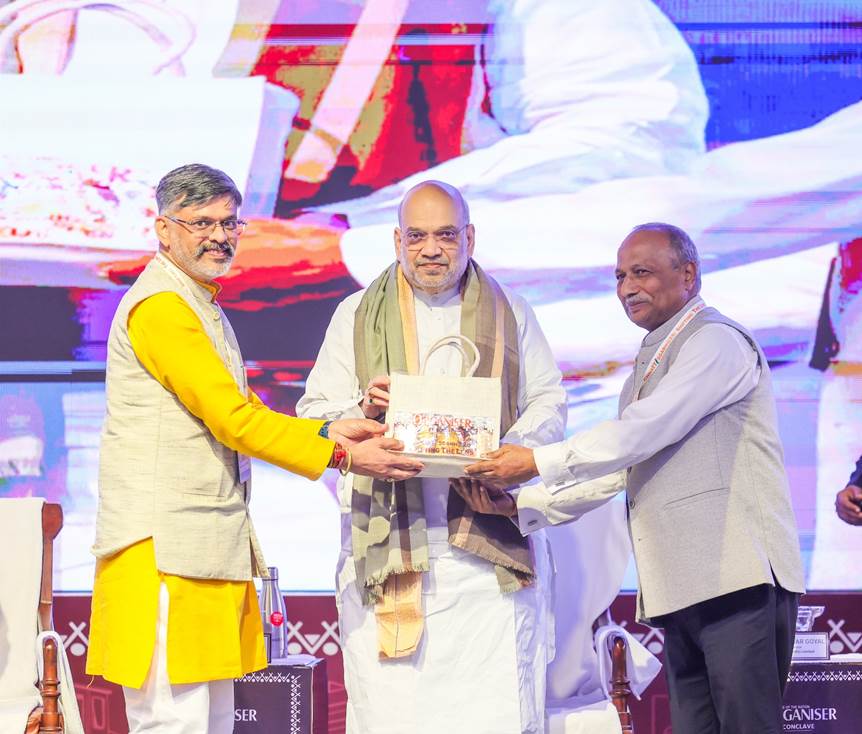
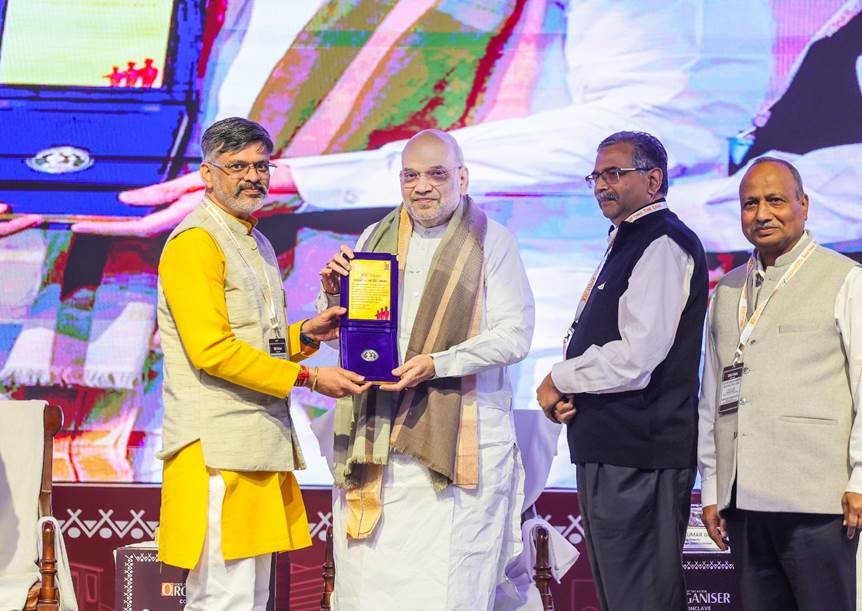
Shah, addressing the national conclave organized in Raipur on the book ‘Chhattisgarh @ 25: Shifting the Lens’, published by ‘Bharat Prakashan’ of the weekly magazine Organizer, said 25 years ago, Chhattisgarh was considered a BIMARU and Naxalism-affected state, but today it has moved out of the BIMARU category and is on the verge of becoming a developed state.
Naxalism here is on the brink of being completely eliminated. This qualitative transformation has been brought about by the governments of his party, which function on the basis of ideology, he said.
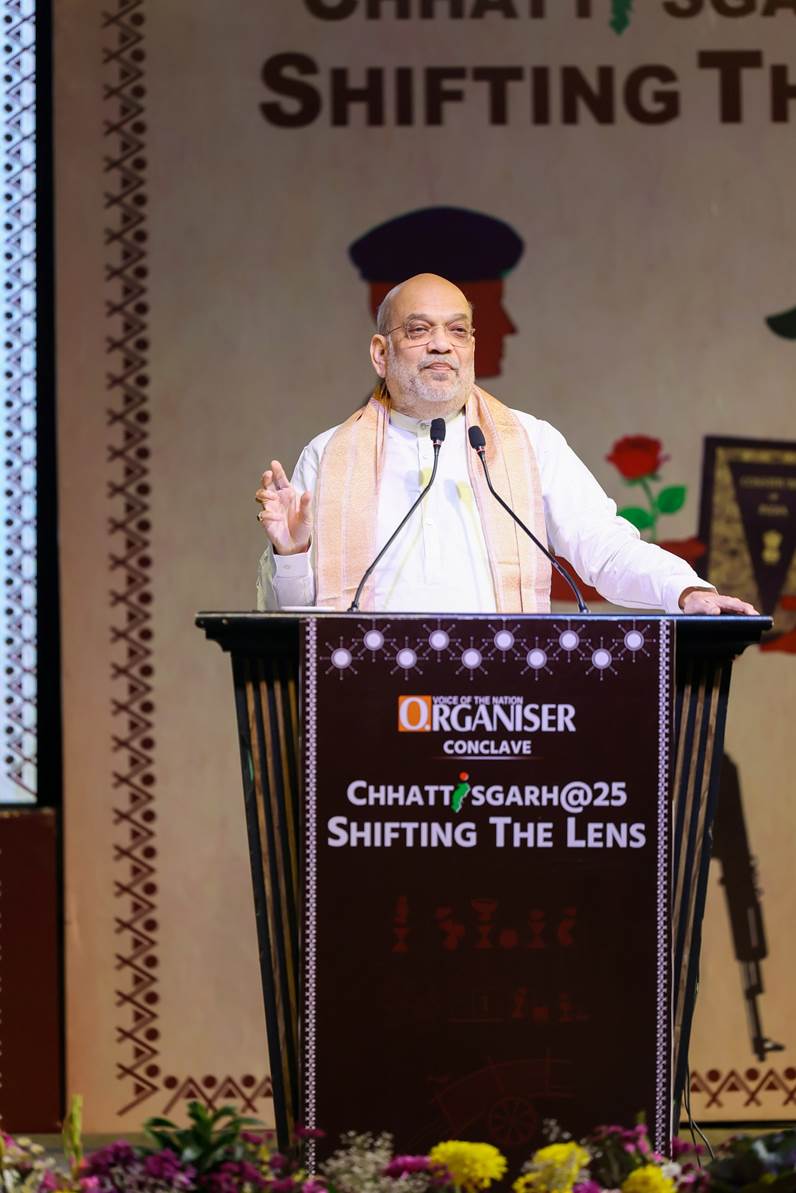
On this occasion, Chhattisgarh Chief Minister Vishnu Dev Sai, Deputy Chief Minister Vijay Sharma, and several other dignitaries were present.
The Union Home Minister said that during the first few years of Chhattisgarh’s 25-year journey, the state was ruled by the opposition party and witnessed atrocities, riots, and several movements.
Thereafter, his party came to power for 15 years, and during these 15 years, Chhattisgarh was taken forward on every dimension of development, Shah said. The then Chief Minister fought against Naxalism and struggled against it, but for most of that period, the opposition party was in power at the Centre.
Shah said that after that, the opposition party formed the government for five years, during which the people of Chhattisgarh were exposed to scams, irregularities, and corruption. As soon as that government came to power, various issues of corruption surfaced in a small state. He added that the then opposition party’s government in Chhattisgarh had provided shelter to the Naxal movement.

After this, his party formed the government again, and a new phase of development began in Chhattisgarh, he said.
Many thinkers have spread the misconception that the problem of Naxalism is linked to development and is merely a law-and-order issue, Shah said adding that when the Naxalite problem began, there were more than 100 districts in the country that were more underdeveloped than Bastar—so why did Naxalism not take root there?
Union Home Minister said that this problem is not connected with law and order or development, but is linked to ideology. He said, if Bastar had not suffered from Maoist violence, this division, rich in immense mineral wealth, would have been the most prosperous region in the country.
He said that the movement is called Maoism because in this ideology, solutions are believed to come only through the gun.
Shah said that Maoists put weapons into the hands of poor, uneducated tribal youth and raised the slogan of a “Red Corridor” from Tirupati to Pashupatinath, thereby holding back the development of this region for four and a half decades.
Maoists trampled upon the development of this region, he said adding that after ten years, Bastar will become the most developed tribal district in the country.
He said, the belief that problems are solved through the gun is a product of Maoist ideology, whereas the spirit of our Constitution lies in dialogue, discussion, and resolution.
Union Home Minister said that those who supported “Red Terror” did not allow development to reach this region for decades. He said that today, schools and hospitals have been rebuilt here, roads have been constructed, rail connectivity is coming, and the Government of India is also going to approve a scheme to irrigate seven lakh hectares of land.
Shah said that thousands of tribal children were killed and their lives were ruined, yet some people are spreading propaganda that the government is firing bullets. He said that the Government of India and the Government of Chhattisgarh do not want to fire at anyone; if all Naxalites lay down their arms, they will be welcomed with a red carpet.
Union Home Minister appealed to the young girls standing with guns in their hands to surrender, as a very good life awaits them ahead.
Shah said that 90 per cent of the area has become free from Naxalism, and before 31 March 2026, the Maoist problem will be uprooted and eliminated from the country.
Chhattisgarh has completed 25 years, and that the state has undergone a major transformation over the past 25 years. Earlier Bihar, Madhya Pradesh, Rajasthan, and Uttar Pradesh were referred to as BIMARU states. Today, Madhya Pradesh and Chhattisgarh, Uttar Pradesh and Uttarakhand, and Rajasthan and Bihar have moved out of the BIMARU category and are standing on the threshold of becoming developed states, Shah said.
A major reason for this is that his party formed governments in these states for long periods, during which a phase of development took place. He added that the governments of his party have established several benchmarks for good governance and administration.
If one compares Chhattisgarh’s budgets of 2000 and 2025, the state’s budget in 2025 has increased 30 fold. Chhattisgarh’s per capita income has increased 17 times, and its GSDP has increased 25 fold, Shah said.
Over the past 25 years, irrigation has doubled, the production of Kharif crops has increased three fold, and Rabi crops have seen an increase of nearly six-fold. He said that earlier there were only seven district hospitals, which have now increased to 30; there was just one medical college earlier, which has now grown to 16; and there has been an 18 fold increase in the number of Anganwadi buildings.
Shah said that earlier the malnutrition-related death rate was 61, which has now come down to 15; the maternal mortality rate was 365 per lakh, which has been reduced to 146 due to the government’s efforts; and the infant mortality rate was 79, which has now come down to 37.
He said that opposition governments had created a new generation of illiterates, whereas now the literacy rate has increased from 65 per cent to 79 per cent. Earlier there was not a single residential Eklavya school, whereas today there are 75, and the number of children studying in hostels has also increased threefold. Rural road construction has increased 98 times, and investment has recorded a 247-fold increase
Union Home Minister said that Chhattisgarh is today moving forward with a growth rate of nearly 7.5 per cent, which is unimaginable. Chhattisgarh has recorded 17 per cent growth in the agriculture sector, 48 per cent growth in the industrial sector, and 35 per cent growth in the services sector.
He said that among governments across the country, if any state government has done the best work for tribal welfare, it is the Chhattisgarh government over the past 25 years.
Talking about the ‘Organiser’, he said it has always maintained the idea of original India in English journalism, has remained firm on it and has worked to present its various dimensions before Indian public. He said that in the same series, a conclave on the theme of security, prosperity, and stability has been organized today under Chhattisgarh @ 25: Shifting the Lens.
Union Home Minister said that the words security, prosperity and stability are very important for any nation or state, and they are even more important for a state like Chhattisgarh, which was formed after Independence.
When Atal Behari Vajpayee became Prime Minister, he decided that the creation of smaller states was not merely an experiment, but a fulfillment of the aspirations of the people there. He added that during the tenure of Vajpayee, the decision was taken to create Jharkhand, Uttarakhand, and Chhattisgarh simultaneously. He said, it is now acknowledged by the entire world that India’s success under the leadership of Prime Minister Modi will lead to global stability and prosperity.
No kind of bitterness arose between the new states formed during Vajpayee’s tenure, but during the formation of a new state, Telangana, under the previous government at the Centre, a great deal of bitterness developed between both Andhra Pradesh and Telangana, which lasted for more than a decade. Even today, several disputes between the two states remain unresolved, he said.
People emerging from his party and ideology work in a very coordinated manner, but when matters are handled purely only through administrative methods, bitterness like that seen between these states arises, he said adding that ideology plays a very important role in politics and it is what drives governance. A political party that lacks an ideology cannot truly work for the welfare of the state or the nation.