
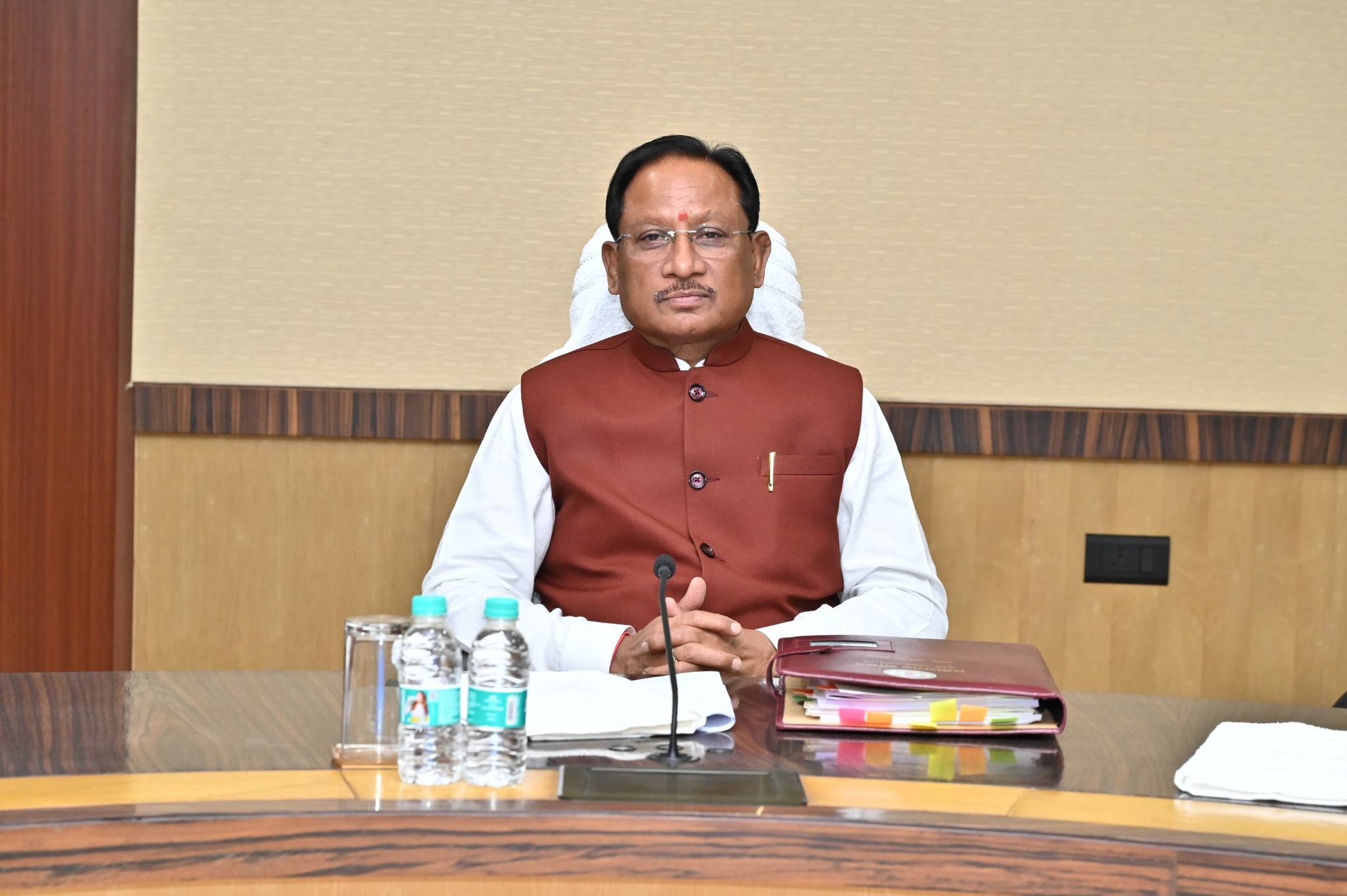
Raipur, July 1, 2026: Chhattisgarh Chief Minister Vishnu Dev Sai today said that Artificial Intelligence (AI) is not merely a technology of the future but an effective medium to elevate good governance, transparency, efficiency, and public service to new heights. He emphasized that Chhattisgarh holds immense potential in the field of AI and will move rapidly towards becoming a leading state in this sector.
A detailed review meeting of the Department of Electronics and Information Technology was held today at the Secretariat Mahanadi Bhawan under the chairmanship of the Chief Minister.
The meeting comprehensively reviewed the progress of various initiatives, including the development and expansion of AI in the state, strengthening of mobile networks, internet connectivity, ‘Seva Setu’, ‘e-Pragati PARAS’ (Project Assessment Review and Analysis System), the Centre of Excellence, data labs, and various digital innovation projects.

Additionally, detailed discussions were held on various aspects such as skill development for the youth, employment generation, strengthening the startup ecosystem, and accelerating technology-driven good governance.
Sai reiterated that Chhattisgarh possesses immense potential in the AI sector and is poised to advance rapidly to become a national leader in this field.
He remarked that AI is not just a future technology but a powerful tool to take good governance, transparency, efficiency, and public service delivery to new levels. Effective use of AI can make the administration more capable, transparent, responsive, and citizen-centric.
The Chief Minister clarified that the state government’s objective is not merely to adopt new technology but to prepare the people of the state for AI, boost business productivity, increase citizens’ incomes, and provide better public services.

He stated that the widespread use of AI in education, health, agriculture, skill development, and daily administrative tasks would directly benefit the common citizens. To achieve this, a robust AI ecosystem will be developed in the state, with top priority given to the use of safe, reliable, and responsible AI.
The vision document presented at the meeting outlined the state’s goal of making Chhattisgarh a national leader in the field of AI—a state where every citizen can learn AI in their own language, the government provides reliable technology-driven services, and industries and businesses gain new momentum.
Work under this mission will focus on five key pillars: AI skill development, innovation and startups, awareness and outreach, safe and responsible AI, and the use of AI in governance.
The presentation highlighted the objective of providing AI training to students and government employees in Chhattisgarh. Initiatives will include AI awareness programmes, AI and robotics clubs, and hackathons in schools. Additionally, AI certification programmes and grants for student projects will be introduced in colleges, while AI labs will be set up in ITIs and Centers of Excellence established in universities.
To foster innovation and startups within the state, support will be extended to AI data labs, Centers of Excellence, AI-based startups, datasets, and research projects. Additionally, an action plan was presented to develop a state-of-the-art AI-based startup ecosystem, incorporating cloud computing facilities, seed funding, and collaborations between industries and academic institutions.
The meeting also featured a detailed discussion on the safe and responsible use of AI. Officials stated that a state-level AI policy would be formulated, incorporating measures for data security, protection of citizen privacy, regular technical audits, and alignment with the Central Government’s Digital Personal Data Protection (DPDP) Act.
To ensure the effective use of AI in governance, AI-based decision-support systems will be developed across various departments; distinct roadmaps will be prepared for each department, and AI nodal officers will be appointed. Furthermore, a target has been set to launch government AI pilot projects. The ‘Bhashini’ platform will also be utilized to provide digital services to citizens in their own languages, thereby making government services simpler, more accessible, and inclusive.
During the review of mobile network expansion, it was reported that the state has achieved a significant milestone by installing approximately 1,000 mobile towers funded by the DBN over the past two and a half years. Additionally, approval has been secured for 577 new mobile towers. Land allocation for 406 of these towers has been completed, while a target has been set to resolve the remaining 171 cases within the next month.
The Chief Minister directed that all necessary measures be completed in a time-bound manner to ensure quality mobile network and internet connectivity in remote and forest areas.
During the review of BharatNet Phase-3, officials stated that 4,114 Gram Panchayats in the state would be connected via a modern network based on ring topology. Additionally, an IP-MPLS-based integrated network will be developed, and the expansion of FTTH services to villages will be ensured, enabling the availability of high-quality internet services in rural areas and ensuring that the benefits of digital services reach the last person.
During the review of the ‘Seva Setu’ portal, it was reported that 520 services from 36 state departments are currently available on the platform, comprising 111 hosted and 409 redirected services. Various government services are being provided to citizens through 16,726 service centers operating across the state. Since April 1, 2025, over 39.75 lakh applications have been received via Seva Setu; of these, 37.52 lakh applications have been successfully resolved, achieving a success rate of 94.3 per cent.
Officials stated that modern features, such as QR-based certificate verification, Aadhaar authentication, DigiLocker integration, treasury and e-challan systems, and DBT-based payments, have been incorporated into Seva Setu, significantly enhancing the transparency, reliability, and convenience of the services.
Ambitious projects such as the establishment of a Center of Entrepreneurship in Naya Raipur, an AI Center of Excellence, data labs, a Security Operations Center, a GIS-based monitoring system, and digital surveillance were also reviewed during the meeting.
Officials noted that these initiatives would provide new momentum to the IT and ITES sectors in the state, boost investment, and create new opportunities for employment and self-employment for thousands of youths.
Senior officials present at the meeting included Chief Secretary Vikas Sheel, Principal Secretary to the Chief Minister Subodh Kumar Singh, Secretary to the Chief Minister Rahul Bhagat, Secretary of the Electronics and Information Technology Department Ankit Anand, Joint Secretary to the Chief Minister Prabhat Malik, and Joint Secretary of the Good Governance and Convergence Department and Chief Operating Officer of CHiPS Mayank Agarwal.
