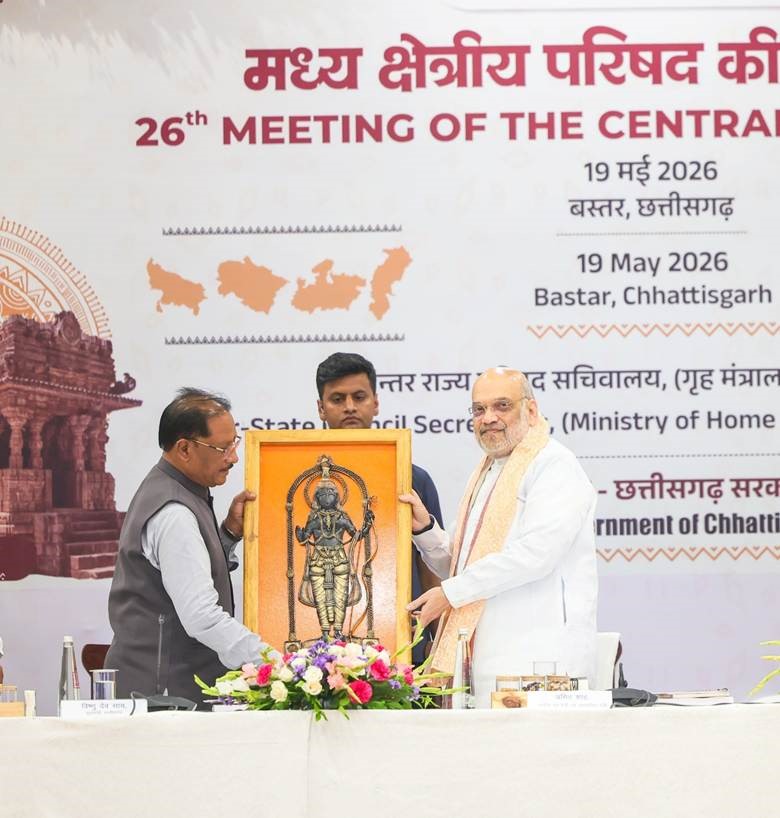
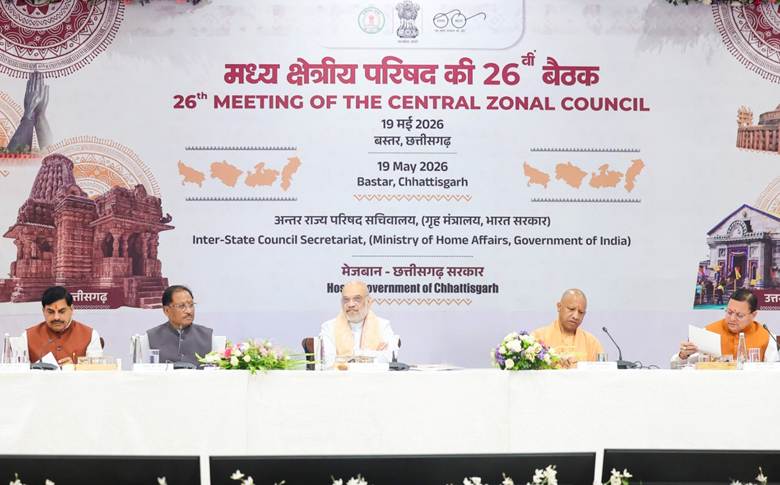
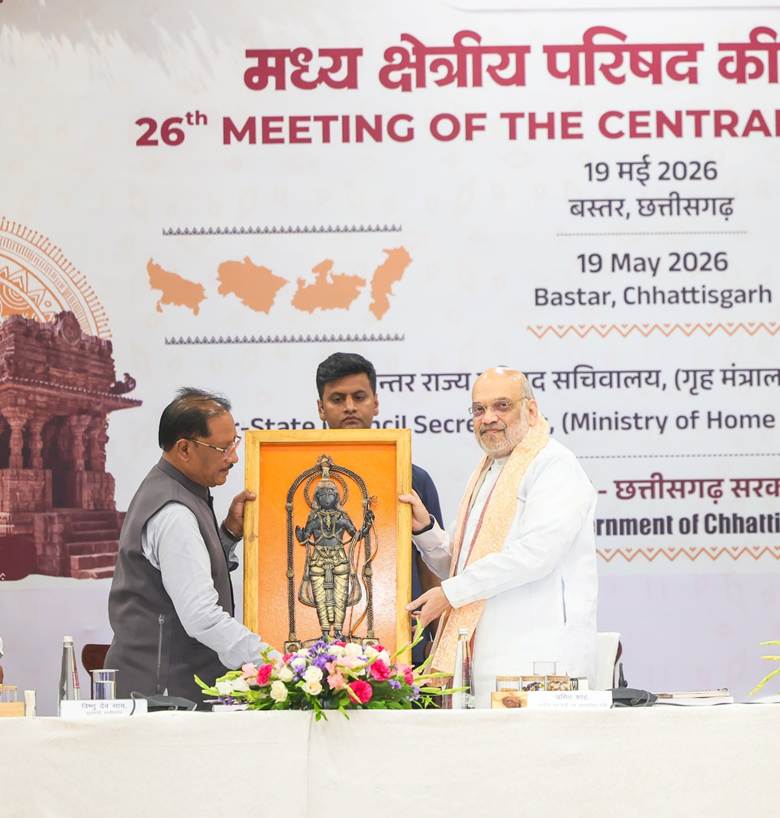
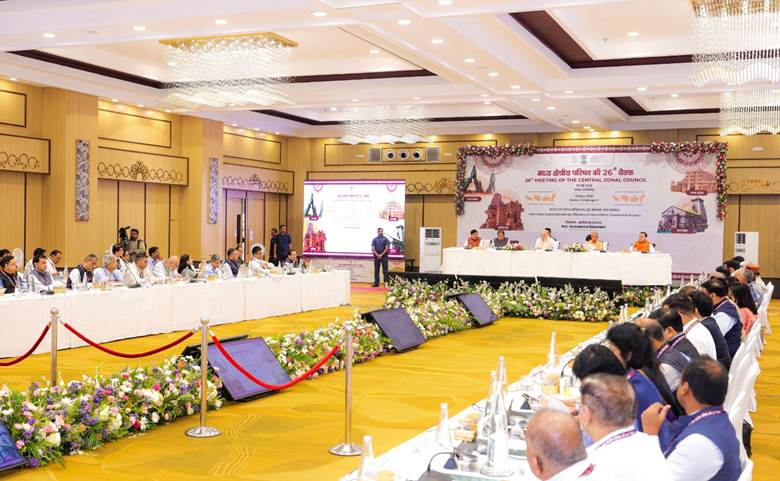
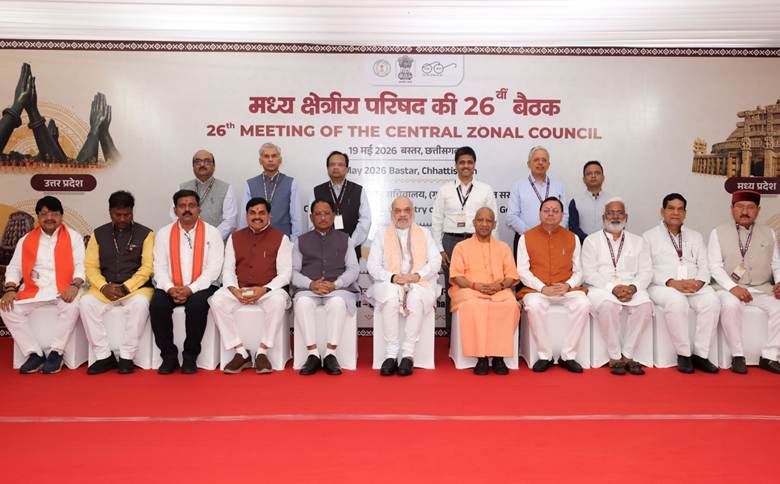
Jagdalpur, May 19, 2026: Union Home and Cooperation Minister Amit Shah today chaired the 26th meeting of the Central Zonal Council (CZC) in Bastar, Chhattisgarh.
The meeting was attended by Chhattisgarh Chief Minister Vishnu Dev Sai, Madhya Pradesh Chief Minister Dr. Mohan Yadav, Uttar Pradesh Chief Minister Yogi Adityanath, and Uttarakhand Chief Minister Pushkar Singh Dhami, along with senior officials from member states and the Central Government.
The meeting was organised by the Inter-State Council Secretariat, functioning under the Ministry of Home Affairs, with the Chhattisgarh Government as the host.
Addressing the meeting, Union Home Minister Shah said that it is a matter of great joy that this meeting is being held in Bastar after achieving the historic milestone of a Naxal-free India. The entire credit for making India Naxal-free goes to the hard work and bravery of the jawans of our security forces.
Our agencies collected inputs with great precision and, in coordination with the police forces of all states and the Central Armed Police Forces (CAPFs), took timely and decisive action on every input. Along with this, under the ‘Whole of the Government Approach’, all state governments and all departments of the Central Government worked together to deliver development to the areas freed from Naxalism, he said.
Shah said that our fight is not over yet because the Naxal-affected areas have been lagging behind in the race for development for nearly five decades. He added that until these areas are brought at par with the rest of the country in terms of development, our fight will not end. On the occasion of the entire country becoming Naxal-free, the Union Home Minister extended his heartfelt congratulations to the Prime Minister Narendra Modi.
Union Home Minister said that whatever was needed by the Chhattisgarh Government in the fight against Naxalism, they coordinated with the Ministry of Home Affairs, Government of India, and ensured it was provided. Wherever leadership was required, the Chief Minister and Deputy Chief Minister provided it. This is the result of their efforts that today Bastar has become Naxal-free.
Shah said that after resolving all disputed issues between the states as well as between the states and the Centre, we are holding this meeting today in a very positive and cordial atmosphere. All the agenda items in today’s meeting were related to the monitoring of development works. He added that under the leadership of Prime Minister Narendra Modi, our federal structure has become stronger and meetings of the Zonal Councils are being held regularly. As a result, in a vast region covering four states, no disputes remain either among the four states or between these states and the Centre. This is a very significant achievement.
Union Home Minister and Minister of Cooperation said that the Central Zonal Council comprises the states of Chhattisgarh, Madhya Pradesh, Uttar Pradesh, and Uttarakhand. This zone stretches from the Himalayan region in the north to the Gangetic plains and further to the plateau regions of central India, which are rich in forests and minerals. These areas are undoubtedly very important for the country’s development.
He said that this region greatly helps in filling the country’s food-grain reserves. The rich mineral deposits of this area provide momentum to the nation’s development, and its rich heritage and culture have played a key role in advancing the country. It is also in this region that almost all the major centres of faith in the country are located in close proximity to one another.
Shah added that Chhattisgarh connects nearly seven states, which gives the entire Central Zone immense strategic importance. The Home Minister said that today this entire region has become not only Naxal-free but also free from disputes, which is a matter of great joy for all of us.
Under the leadership of Prime Minister Narendra Modi, a robust and vibrant mechanism for Zonal Council meetings has been established. We have made it decisive, brought continuity to it, and made it result-oriented. In the 10 years from 2004 to 2014, only 11 meetings of the Zonal Councils were held. This number has increased to 32 meetings between 2014 and 2026. During 2004 to 2014, the Standing Committee held only 14 meetings, which have risen 2.5 times to 35 meetings between 2014 and 2026. He said that between 2004 and 2014, discussions were held on just 569 issues, whereas from 2014 to 2026, discussions have taken place on 1,729 issues, out of which nearly 80 per cent have also been resolved. A large number of the pending issues are related to monitoring, in which there is no dispute of any kind.
Union Home Minister said that we should focus on Jal Jeevan Mission-2 and arrangements should be done to provide tap water to every household. He said that health, nutrition, and social welfare are extremely sensitive issues. The Home Minister called upon all the Chief Ministers and Chief Secretaries to join hands and move forward shoulder to shoulder with the Government of India in the fight against malnutrition.
He added that a lot of work still needs to be done in the field of education to reduce school dropout rates and improve the quality of schools. Financial inclusion and power sector reforms can make a very significant contribution in transforming this developing region into a fully developed one.
Shah said that work should proceed with even greater momentum in the four sectors of urban planning, public health, financial inclusion, and power sector reforms. The Home Minister appealed that at least 50 per cent of our attention should remain focused on rural development and schemes that empower individuals.
The Home Minister said that ensuring the availability of banking facilities within a 5-kilometre radius is a significant achievement, because all our government schemes are based on Direct Benefit Transfer (DBT). Therefore, all states need to make concrete and serious efforts in this direction.
Shah said that if timely DNA testing is conducted in POCSO and rape cases, the conviction rate in these cases can increase to 100 per cent. High Courts should establish special courts for the speedy disposal of cases pending in courts for more than five years. The administration must demonstrate such seriousness in dealing with serious crimes.
He urged the Chief Ministers of all four states to implement their state-level 1930 helpline in accordance with the model format of the Union Ministry of Home Affairs (MHA) and to update the call centres of the state helplines.
Shah said that in cases of adulteration, wherever a case is registered and a penalty is imposed, there should be proper arrangements to publicise it widely. He added that this would make the public aware that adulterated items are being sold in those guilty shops.
Union Home Minister and Minister of Cooperation said that the three Naveen Nyaya Sanhita of the criminal justice system have been implemented very effectively.
He added that there are still many issues in their implementation on which we need to put greater emphasis.
The Home Minister said that just as we have freed the country from Naxalism, similarly, we must achieve the target of disposing of every criminal case – right up to the Supreme Court – within three years, before 2029.